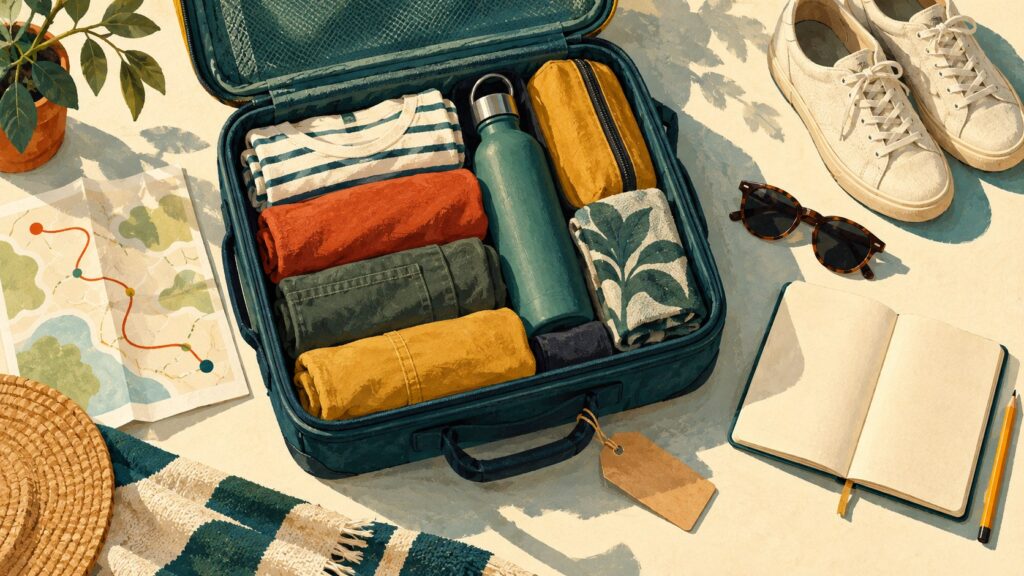
The main advantage of a smaller bag appears when you move: through a station, onto another train, along an unfamiliar street, or into accommodation with limited space. But travelling with a carry-on is not automatically the right choice for every person or trip. Equipment, accessibility needs, weather, and carrier rules may justify more luggage.
If a carry-on fits your circumstances, build the bag around the route rather than a universal packing list. This guide uses a practical system: establish the constraints, select a repeatable clothing set, protect essentials, and test the result before leaving.
Check the strictest relevant allowance
List every flight and other booked transport leg. Read each operator's current size, weight, and item allowances for the fare you actually purchased. A bag sold as “cabin size” is not proof that it meets every carrier's conditions.
Check whether a separate personal item is included and how measurements are defined. A connection operated by another carrier may have different rules. Do not assume the allowance on the first flight describes the whole itinerary.
Keep baggage permission separate from security screening. An item can fit within the bag allowance and still be restricted by a security authority or destination rule. Use the responsible official source for the relevant question.
Pack for the longest gap between laundry
Count the days between realistic laundry opportunities. A week-long trip with convenient washing access may require fewer clothes than a shorter itinerary where laundry is difficult.
Verify the accommodation's facilities or nearby options before relying on them. Consider cost, time, and drying conditions. Washing something at night is not helpful if it remains wet when you must repack the next morning.
Select a small clothing set that works together. The goal is not to wear the same outfit regardless of circumstances; it is to avoid packing several items that perform the same job without a clear reason.
Give every bulky item a role
Shoes, jackets, and equipment often dominate the bag. For each, identify the activity or condition that requires it. If two items solve the same problem, decide whether the duplicate is genuinely useful.
Wear appropriate bulky clothing during travel when comfortable, but do not rely on an impractical costume to evade a luggage limit. The bag should remain manageable and compliant when you are not wearing every layer.
If one special activity requires substantial equipment, compare renting suitable gear, checking a bag, or changing the activity. The lightest possible bag is not a better outcome if it leaves you inadequately prepared.
Separate the items you cannot easily replace
Create a compact essentials group containing necessary documents, payment methods, required personal items, and information needed for arrival. Store it so you can retain it if an airline requires your main cabin bag to be checked.
Follow relevant requirements for medicines, batteries, and other regulated items. Do not infer permission from a generic packing article. Check your carrier and the responsible security or border authority for your route.
Keep a secure backup of essential information without exposing sensitive details unnecessarily. A written accommodation address and a private document backup serve different purposes and should be handled accordingly.
Use organization that reduces searching
Packing cubes or simple pouches can help group clothing, toiletries, and electronics, but they are optional. Choose a system you can remember rather than buying an accessory for every category.
Place frequently used items where you can reach them without emptying the bag. Keep a layer, a charging cable, and arrival information accessible if those are likely to be needed in transit.
Leave room for repacking. A bag that closes only after careful compression at home may become frustrating during a short hotel stay. The system should still work when you are tired and have less time.
Build a modest toiletries plan
List the products you use and the quantities required for the trip. Avoid carrying full-size duplicates without a reason. Check what the accommodation provides, while remembering that availability and personal suitability can vary.
Review current security rules for liquids, gels, aerosols, and any exceptions relevant to you. The TSA provides guidance for US screening, but your journey may involve other authorities as well. Do not apply one country's rules automatically to every checkpoint.
Use secure containers and keep them separate from documents and electronics. A small leak can create more disruption than the space saved by an unreliable bottle.
Reduce the electronics set
Write down each device's purpose. If a phone already performs a task adequately, decide whether another device adds enough value to justify its weight and charger. There is no need to eliminate equipment you genuinely use.
Check charging specifications and socket compatibility before selecting adapters. A plug adapter changes the physical connection; it does not necessarily convert voltage. Follow the specifications printed on the device and charger.
Keep essential cables identifiable. Download supported maps, language resources, and tickets where permitted, and test offline access. A smaller electronics kit should still support the functions your trip depends on.
Rehearse the complete bag
Pack everything, then measure and weigh the bag according to the relevant operator instructions. Lift it and carry it in a realistic way. If your route includes stairs, consider whether you can manage the bag safely under those conditions.
Practise reaching the items you will need at departure, arrival, and the first accommodation stop. If you must unpack half the bag to find a document, change the layout.
The rehearsal should include the return journey. Leave room for anything you intend to bring home or plan a compliant alternative. Souvenirs do not automatically create extra baggage allowance.
Use a last-edit checklist
| Question | What it reveals |
|---|---|
| Which activity needs this item? | Whether it has a real purpose |
| Does another packed item do the same job? | Possible duplication |
| Can I access essentials quickly? | Layout problems |
| Does the bag meet every relevant rule? | Route-specific constraints |
| Can I carry it comfortably? | Practical limits beyond size |
Do not remove essential equipment simply to achieve an arbitrary weight target. The right bag supports the trip you are actually taking and the needs of the person carrying it.
Keep the system useful during travel
Return items to their usual place after each use. Before leaving accommodation, check a short fixed list: documents, payment items, chargers, required personal items, and anything stored separately.
Notice what remains unused and why. An emergency item may be worth carrying even when not needed; a duplicate outfit may be easier to omit next time. Use the distinction to improve your list rather than judging every unused object as a mistake.
Good carry-on packing is a balance of preparation and mobility. It succeeds when you can move through the itinerary with the things you need, within the applicable rules, without spending each transfer reorganizing your belongings.
Official screening reference
- TSA: travel tips — US screening guidance. Consult each carrier and other applicable security authorities separately.
Keep exploring
- What to Pack for Canada: Start with the Route and Forecast
- Prepare an Offline Translation Kit Before You Travel
- Train or Plane? Compare the Journey You Will Actually Take